China Best Electric Drive Motor Suppliers Guide

Time:2026-10-07 Author:Charlotte
0%

China’s electric vehicle supply chain has moved from scale to deeper integration. The IEA’s Global EV Outlook 2025 reports that global electric car sales exceeded 17 million units in 2024. China accounted for more than 11 million of those sales. Nearly half of all new cars sold in China were electric. This volume creates strong demand for efficient, durable, and highly integrated Electric Drive Motor systems.

China’s best suppliers are not judged by motor output alone. A serious evaluation should examine peak torque, continuous power, efficiency maps, cooling design, noise, vibration, and thermal durability. It should also review inverter integration, e-axle packaging, software calibration, and production consistency. CAAM reported that China produced about 12.89 million new energy vehicles in 2024. Such production scale can support competitive pricing. It can also hide uneven quality between suppliers.

This guide compares leading Chinese manufacturers through technical capability, factory experience, certifications, delivery performance, and customer support. IATF 16949, ISO 26262 processes, and traceable end-of-line testing deserve close attention. Field performance matters more than a polished brochure. Ask for efficiency curves, not only headline figures. Request test conditions, warranty data, and sample validation records. No supplier ranking remains permanent. That is an uncomfortable limitation. Component platforms, raw material costs, and vehicle architectures change quickly. Buyers should therefore treat this guide as a practical starting point, then verify each supplier against their vehicle’s voltage, torque, cooling, and duty-cycle requirements.
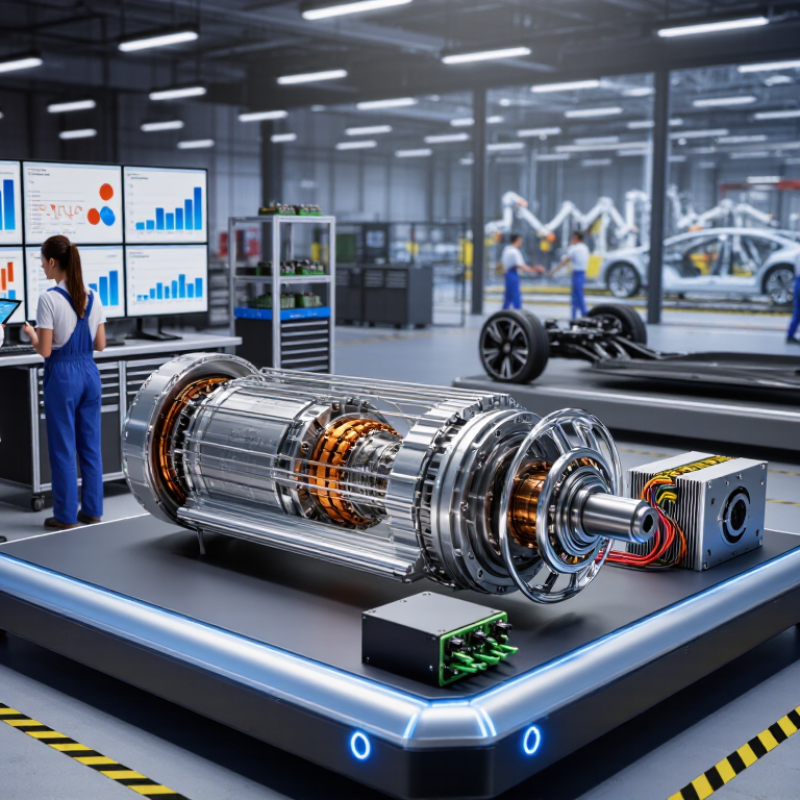
China Best Electric Drive Motor Suppliers Guide

What Electric Drive Motors Are and How They Power Modern Vehicles

An electric drive motor converts electrical energy into wheel movement. It does not burn fuel inside the motor. Instead, battery direct current reaches an inverter, which creates controlled three-phase current. Magnetic fields then rotate the motor shaft. A reduction gear transfers that rotation to the wheels. The process feels immediate. Pressing the accelerator can produce torque within milliseconds. In city traffic, this response helps a vehicle move smoothly from a red light.

Most modern vehicles use permanent-magnet or induction designs. Each choice affects cost, efficiency, heat, and operating range. The inverter adjusts voltage and frequency several thousand times per second. Sensors monitor rotor position, current, and temperature. Cooling channels may carry liquid around the stator housing. Without careful thermal control, power output must drop. That limitation is easy to miss in supplier brochures. A credible supplier should provide efficiency maps, continuous-power ratings, insulation data, and test conditions. Peak power alone tells little about daily performance.

During testing, engineers compare the motor across slow traffic, highway speeds, steep grades, and repeated acceleration. A motor may reach high efficiency near one speed, then lose it elsewhere. Regenerative braking sends some kinetic energy back to the battery, but never all of it. Energy conversion always has losses. Real vehicles also face cold weather, heavy loads, tire resistance, and imperfect calibration. I would question any claim that ignores those details. Supplier selection should include durability cycles, acoustic measurements, service procedures, and traceable quality records. Small noises matter. They can reveal imbalance, bearing wear, or weak assembly control.

Key Motor Types Used by Chinese Electric Drive Motor Suppliers

China Best Electric Drive Motor Suppliers Guide

Chinese electric drive motor suppliers commonly offer several motor types for vehicles, pumps, conveyors, and automation equipment. Permanent magnet synchronous motors deliver high efficiency and strong torque at low speed. They suit electric vehicles and compact industrial drives. Brushless DC motors use similar magnetic principles, but usually target smaller systems, such as cooling fans, robotic joints, and light mobility equipment. Their simple electronic control supports quiet operation.

Induction motors remain practical for factories because they are durable, cost-sensitive, and less dependent on permanent magnets. They perform well in pumps, compressors, and heavy conveyors. However, their efficiency can drop during partial-load operation.

Switched reluctance motors offer a robust rotor and wide speed range. They can tolerate high temperatures, though vibration and acoustic noise require careful control.

Some suppliers also develop in-wheel motors for compact vehicles. These designs reduce transmission parts but expose the motor to road shocks and water.

A reliable supplier should provide torque-speed curves, efficiency maps, insulation data, and thermal test results. Ask about continuous torque, peak torque, duty cycle, cooling method, and ingress protection.

Factory testing should include rotor balance, winding resistance, vibration, and load performance.

Supplier documents may look complete. Sometimes they are not.

A test curve at one voltage cannot represent every operating condition. Buyers should request samples and repeat tests under real temperatures, loads, and controller settings.

Small details matter.

How to Compare China’s Electric Drive Motor Manufacturers

Comparing China’s electric drive motor manufacturers requires more than checking rated power and quoted prices. Study the motor’s torque curve, efficiency map, cooling method, insulation class, and operating temperature. Ask for test reports from controlled conditions. A motor rated at 100 kW may perform differently under repeated acceleration, heavy loads, or poor ventilation. Request sample units before approving large orders. Measure vibration, noise, temperature rise, and energy use during realistic duty cycles. Field experience matters.

Tips: Build one comparison sheet for every supplier. Record winding materials, bearing sources, controller compatibility, warranty terms, and delivery history. Check whether the factory owns its testing equipment or outsources critical inspections. Ask to see calibration records and production samples. These details often reveal more than polished presentations.

Reliable manufacturers explain technical limits clearly. Be cautious when a supplier promises unusually high efficiency without showing test conditions. Verify quality systems, traceability, incoming-material checks, and final inspection procedures. Review compliance documents for your target market, but do not treat certificates as proof of consistent performance. Speak with engineering staff, not only sales representatives. Their answers should remain consistent across drawings, samples, and contracts.

A factory visit can expose practical weaknesses. Look for clean assembly areas, controlled storage, and documented rework. I would also compare response time after a technical problem. Price remains important, yet a cheaper motor can increase downtime and integration costs. One comparison can still be imperfect. Real vehicle data may challenge laboratory results. That is why staged testing and careful records are worth the effort.

Production Standards, Quality Checks, and Certification Requirements

Selecting an electric drive motor supplier requires more than a high-efficiency claim. The IEA Global EV Outlook 2024 reported nearly 14 million electric car sales in 2023. That growth increases pressure on suppliers to prove repeatable production quality.

A reliable factory should control copper winding tension, rotor balance, magnet placement, insulation thickness, and sealing torque. Each motor needs traceable records, not only a final inspection. Production systems commonly align with ISO 9001, while automotive programs may require IATF 16949. Electrical rotating-machine tests should reference IEC 60034, including efficiency, temperature rise, vibration, and insulation performance. Safety-related applications may also require ISO 26262 processes.

Test the details.

Quality checks should include no-load speed, rated-load efficiency, dielectric strength, surge testing, noise, vibration, and thermal endurance. End-of-line data should connect each motor to its materials, operator, equipment, and software version. For road vehicles, UNECE R100 may apply to rechargeable electrical powertrain safety, depending on the target market. Certification is not universal; assess the destination country and vehicle category.

Factory audits should review calibration intervals, failure analysis, corrective actions, and sample retention. Ask for recent test reports from independent laboratories. A certificate alone proves limited capability. In practice, supplier evidence can be incomplete, and that deserves scrutiny. I would also compare three months of process data, rather than trust one impressive sample. Loose tolerances often appear only after heat cycling, vibration, or extended production runs.

Selecting the Right Supplier for Your Electric Drive Motor Project

Selecting the right Chinese electric drive motor supplier requires more than comparing prices. Your project may need a motor for an electric vehicle, industrial conveyor, pump, or automated machine. Each application demands different torque, speed, cooling, protection, and control features.

Ask suppliers for complete datasheets, winding specifications, efficiency curves, noise limits, and thermal test records. Check whether the factory performs rotor balancing, insulation testing, and end-of-line performance checks. A video call can reveal useful details, such as calibration equipment, assembly procedures, and production cleanliness. Details matter. Request a sample motor before approving a large order. Measure starting torque, temperature rise, vibration, and current under your real operating load.

Reliable suppliers explain design limits instead of promising everything. They should provide traceable test reports, clear warranty terms, spare-part support, and realistic production timelines. Review their quality certificates, export experience, and communication process. Ask who handles engineering changes after approval. This question often exposes weak project control.

Do not choose only by the lowest quotation. A cheaper motor may use different magnets, thinner insulation, or less effective cooling. Those savings can disappear through overheating and early maintenance. A polished factory presentation can still hide inconsistent testing. Keep your evaluation objective. Use a written scorecard and record every technical commitment. My own assessment would remain cautious when a supplier avoids sharing raw test data. A good relationship helps, but measurable performance matters more.

China Best Electric Drive Motor Suppliers Guide - Selecting the Right Supplier for Your Electric Drive Motor Project

Evaluation Dimension Recommended Benchmark Why It Matters Supplier Evidence to Request Decision Priority
Motor Topology Permanent-magnet synchronous motor for high efficiency and compact size; induction motor for ruggedness and lower material sensitivity; BLDC motor for compact low-to-medium power systems. The motor topology affects efficiency, control complexity, cost, thermal behavior, and maintenance requirements. Motor design description, operating maps, control compatibility, and application references with comparable duty cycles. High
Rated Power Range Select a supplier whose standard or configurable range covers the required continuous power with at least 10% to 20% design margin. Adequate margin helps accommodate peak loads, ambient-temperature changes, aging, and production tolerances. Rated and peak power curves, continuous-duty data, overload capability, and application-specific sizing calculations. High
Voltage and Current Compatibility Confirm compatibility with the system DC bus or AC supply, including maximum voltage, continuous current, peak current, and insulation requirements. Electrical mismatch can cause inverter faults, excess heating, insulation stress, or reduced usable torque. Voltage-current curves, inverter interface specification, insulation-system data, and dielectric-strength test results. High
Efficiency Performance Use an efficiency map rather than a single rated-point value; evaluate performance across the actual speed-torque operating region. IE3, IE4, and IE5 classifications may apply to eligible AC motors under IEC 60034-30-1. Drive-cycle efficiency directly affects energy consumption, battery size, operating cost, and thermal load. Test reports, efficiency maps, measurement method, test conditions, and calibration records. High
Torque and Speed Capability Verify continuous torque, peak torque, base speed, maximum speed, and field-weakening or overspeed capability against the complete duty cycle. The correct speed-torque envelope prevents stalling, overheating, poor acceleration, and mechanical overstress. Speed-torque curves, peak-duration limits, overspeed test results, and duty-cycle simulation. High
Thermal Management Choose natural, forced-air, or liquid cooling according to continuous load, installation space, ambient temperature, and allowable winding temperature. Thermal limits determine continuous output, service life, demagnetization risk, and enclosure requirements. Thermal model, temperature-rise test, cooling-flow requirements, sensor layout, and derating curves. High
Ingress Protection Use IP54 or higher for protected industrial environments; consider IP65 or higher where dust, water jets, or outdoor exposure are expected, subject to the applicable IEC 60529 test conditions. The enclosure rating influences reliability in dusty, wet, washdown, or outdoor installations. IP test report, sealing design, connector rating, shaft-seal specification, and installation limitations. Medium-High
Insulation and Temperature Class Class F insulation is commonly used for industrial motors; Class H may provide additional thermal margin when supported by the complete design and test data. Insulation capability affects winding durability, inverter-pulse withstand, and allowable temperature rise. Insulation-system specification, partial-discharge or impulse test information where applicable, and temperature-rise results. Medium-High
Control and Position Feedback Confirm compatibility with resolver, encoder, Hall sensor, sensorless control, or other feedback requirements, including signal type and resolution. Feedback compatibility affects start-up performance, low-speed torque, positioning accuracy, and system integration time. Feedback interface specification, wiring diagrams, control parameters, software support, and commissioning procedure. High
Mechanical Integration Check mounting dimensions, shaft geometry, bearing arrangement, radial and axial loads, vibration limits, and allowable coupling misalignment. Mechanical incompatibility can create installation delays, excessive vibration, bearing damage, or premature failure. 2D drawings, 3D CAD files, tolerance data, balance grade, bearing life calculation, and vibration test results. High
Noise and Vibration Define maximum sound-pressure level and vibration limits for the complete motor-drive assembly, not only the motor at no-load. Acoustic and vibration performance affects user comfort, equipment life, product acceptance, and regulatory compliance. Noise spectrum, vibration measurements, balancing records, test setup, and operating-speed conditions. Medium
Quality Management Prefer a documented quality system, traceable production records, incoming-material controls, end-of-line testing, and corrective-action procedures. Consistent process control reduces variation, field failures, warranty costs, and launch risk. Quality certificates, process flow, control plan, capability data, audit results, and sample inspection reports. High
Prototype and Validation Support Supplier should support sample builds, parameter tuning, thermal validation, endurance testing, and design changes before mass production. Early engineering support shortens integration time and identifies performance or reliability issues before production. Development schedule, validation matrix, sample lead time, test capacity, engineering contacts, and change-control process. High
Production Capacity and Lead Time Evaluate monthly capacity, bottleneck processes, standard lead time, peak-season capacity, and capacity allocation for the project. Capacity risk can interrupt launches, increase inventory requirements, and limit demand response. Capacity statement, production plan, equipment list, historical delivery performance, and contingency plan. Medium-High
Total Cost of Ownership Compare unit price together with tooling, inverter compatibility, cooling hardware, efficiency losses, maintenance, warranty, logistics, and spare parts. The lowest purchase price may not deliver the lowest lifetime operating cost or project risk. Detailed quotation, tooling terms, energy-consumption estimate, warranty conditions, service rates, and replacement-part pricing. High
Compliance and Documentation Require applicable electrical, EMC, safety, environmental, and export documentation for the target market and final equipment. Complete documentation supports certification, customs clearance, customer audits, and safe commissioning. Declarations, test reports, material declarations, technical datasheets, installation manuals, and maintenance instructions. High
Warranty and After-Sales Service Assess warranty duration, response time, failure analysis, spare-parts availability, remote support, and local service capability. Effective support reduces downtime and protects the project during ramp-up and field operation. Warranty policy, service-level agreement, escalation process, repair procedure, spare-parts list, and failure-report template. Medium-High
Recommended supplier-selection method: Score each supplier from 1 to 5 for technical fit, quality, delivery capability, documentation, service, and total cost of ownership. Require written evidence for every score and validate the shortlisted motor through a sample test under the actual project duty cycle.

FAQS

How does an electric drive motor move a vehicle?

Battery electricity reaches an inverter, which creates controlled three-phase current. Magnetic fields rotate the motor shaft. A reduction gear turns the wheels. Acceleration can feel almost immediate.

Why are an inverter and sensors important?

The inverter adjusts voltage and frequency thousands of times per second. Sensors track rotor position, current, and temperature. These controls support smooth movement and protect components from excessive heat.

What motor designs are commonly used?

Permanent-magnet and induction designs are common. They differ in cost, efficiency, heat management, and operating range. The better choice depends on the vehicle’s duty cycle.

Why is peak power not enough for comparison?

Peak power may last only briefly. Continuous-power ratings reveal more about daily performance. Request torque curves, efficiency maps, cooling details, and test conditions. Brochures can hide limitations.

What should buyers measure during sample testing?

Test sample motors in traffic, highway driving, steep grades, and repeated acceleration. Measure temperature rise, vibration, noise, energy use, and response. Real conditions matter more than one laboratory result.

How can a factory’s production quality be checked?

Review winding tension, rotor balance, magnet placement, insulation thickness, and sealing torque. Each unit should have traceable material and test records. Check calibration dates and retained samples.

Which quality documents should a supplier provide?

Request efficiency, insulation, thermal, vibration, and endurance reports. Review applicable quality-system and vehicle-safety compliance documents. A certificate alone proves limited capability. Evidence can still be incomplete.

Why does thermal control affect motor performance?

Cooling channels may carry liquid around the stator housing. Without effective cooling, power output must decrease. Test motors after heat cycling and heavy loads. Small noises may reveal imbalance or bearing wear.

What should a factory visit reveal?

Look for clean assembly areas, controlled storage, documented rework, and visible inspection equipment. Ask how failures are analyzed and corrected. I would also check technical response times. Price is important, but downtime can cost more.

Conclusion

This guide explains what an Electric Drive Motor is and how it converts electrical energy into mechanical power for modern vehicles. It introduces the main motor types commonly offered by Chinese suppliers, comparing their structure, efficiency, torque performance, cooling methods, control compatibility, and suitability for passenger cars, commercial vehicles, and specialized applications. Understanding these differences helps buyers evaluate technical options more accurately.

The guide also outlines how to compare manufacturers by examining engineering capability, production capacity, quality-control procedures, testing equipment, delivery reliability, and after-sales support. It highlights the importance of production standards, performance validation, safety inspections, and relevant certification requirements before placing an order. Finally, it provides practical considerations for selecting the right supplier, including project specifications, operating conditions, customization needs, target cost, expected production volume, and long-term cooperation potential.

Charlotte

Charlotte

Charlotte is a seasoned marketing professional with a deep understanding of the company's portfolio and a passion for elevating its presence in the market. With a keen eye for detail and a commitment to excellence, she ensures that our professional blog is regularly updated with insightful articles......