Choosing a Gear Reduction Motor is not simply a matter of matching horsepower. Speed, torque, duty cycle, load behavior, noise, heat, and installation space all influence the result. The International Energy Agency reports that electric motor systems consume roughly 46% of global electricity. The U.S. Department of Energy also identifies motor-driven equipment as a major share of industrial electricity use. Small selection errors can therefore increase energy loss, maintenance frequency, and production downtime.
Market reports show continued demand for compact and efficient geared systems. Grand View Research estimates that the global gear motor market was worth more than USD 27 billion in 2023, with steady growth expected through 2030. However, market growth does not guarantee a suitable purchase. A motor that performs well on a test bench may struggle with shock loads, frequent starts, or poor lubrication in a factory. Dr. Alexander Slocum, an MIT mechanical engineering professor, often teaches a practical design principle: “The best design is the simplest one that works.” That idea deserves a careful challenge here. The simplest option is not always the most reliable one.
This guide presents seven practical tips for choosing a Gear Reduction Motor. It considers output torque, reduction ratio, motor efficiency, gearbox type, service factor, environmental protection, and supplier support. Check the real load, not only the catalog rating. Measure the duty cycle. Leave room for uncertainty. A well-selected unit should deliver controlled motion, manageable heat, and predictable service life.
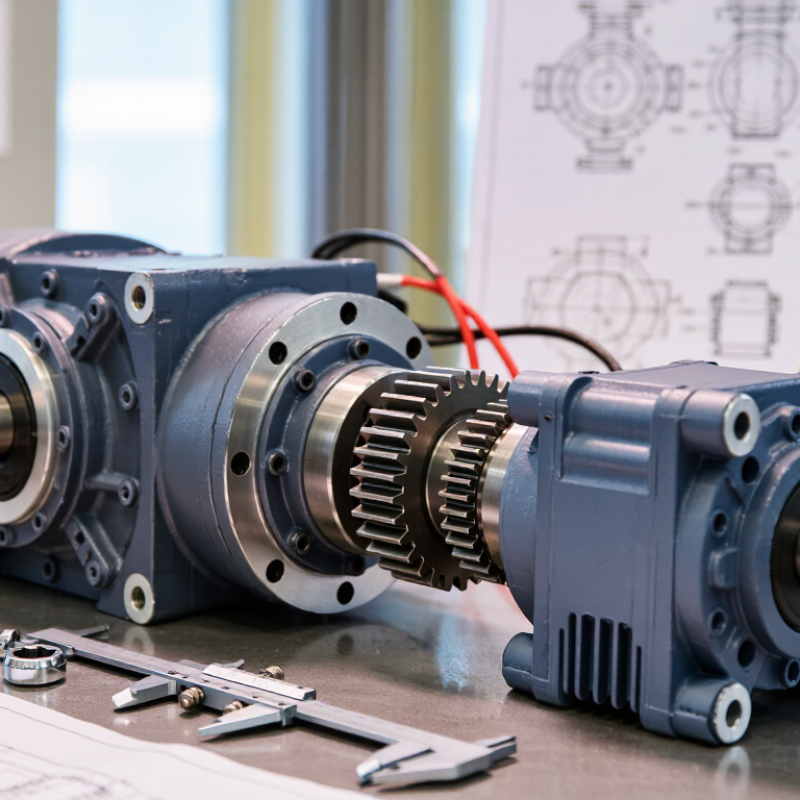
Choosing a gear reduction motor starts with two practical numbers: target output speed and required shaft torque. Before comparing motors, measure the load, not only the machine’s ideal operating condition. Use the reduction ratio formula: input speed divided by desired output speed.
For example, a motor running at 1,750 revolutions per minute must drive a conveyor at 70 revolutions per minute. This requires a 25:1 reduction ratio. Small errors matter. If the conveyor needs 12 newton-meters of torque, include gear efficiency, starting resistance, and a suitable service factor. A motor rated exactly at 12 newton-meters may struggle during startup.
Torque demand can change when the belt is cold, the load is uneven, or the machine cycles frequently. Record peak torque, running torque, duty cycle, and acceleration time. Do not guess. Check the manufacturer’s performance data at the actual output speed, because rated torque may vary across the operating range. I have seen designs pass bench testing but fail after continuous production use. That usually reflects an optimistic load estimate, not a mysterious motor problem.
Leave reasonable capacity for real operating conditions, but avoid excessive oversizing. A much larger motor can increase cost, noise, and mechanical stress. Test the selected unit with the heaviest expected load, then review temperature, vibration, and speed stability. The first calculation is useful, but it should not be the final decision.
A gear motor should fit the workplace, not merely the speed and torque chart. The IEA’s Energy Efficiency 2023 analysis places electric motor systems near half of global electricity use. Small efficiency losses can become expensive over long operating hours.
For dusty conveyors, enclosed induction motors with suitable ingress protection are often practical. For washdown areas, check corrosion resistance, seals, cable glands, and the complete IP rating. IEC 60529 defines IP protection levels, but an IP rating does not guarantee chemical resistance. That distinction is easy to miss. In cold rooms, confirm starting torque, lubricant viscosity, and cable flexibility. In high-temperature zones, derating may be necessary. A motor rated for 40°C ambient air may deliver less power at 60°C.
Servo motors suit frequent acceleration, precise positioning, and changing loads. Their feedback systems improve control, but they need careful tuning and cleaner installation. Stepper motors can offer economical positioning at low speeds, yet overloaded systems may lose synchronism without obvious warning. Induction motors remain reliable for steady-duty applications. The U.S. Department of Energy has estimated that motor systems consume about 68% of industrial electricity, making correct selection important for operating costs.
A practical check is to record duty cycle, starts per hour, ambient temperature, dust, moisture, and cleaning chemicals. Then compare those conditions with the motor, gearbox, brake, and lubricant specifications. The first selection is rarely perfect. Field conditions often expose assumptions that laboratory ratings cannot.
Start with the real load, not the motor’s advertised power. Measure running torque, startup torque, speed, and shaft diameter. Include friction, belt tension, shock loads, and stopping demands. A gearbox rated for average torque may fail during repeated starts.
The U.S. Department of Energy reports that motor-driven equipment uses about 70% of industrial electricity. Small sizing errors can therefore increase both energy use and maintenance costs. Measure twice.
Match the motor to its duty cycle. IEC 60034-1 defines operating types from continuous S1 duty to intermittent and cyclic S3–S9 duty. Record operating time, rest time, starts per hour, and reversing frequency. Continuous operation needs stable thermal capacity. Short cycles may permit higher temporary loads, but only within the manufacturer’s thermal limits. Heat matters. According to the IEA’s Energy Efficiency 2017 report, electric motor systems consume more than half of global electricity. Efficiency deserves attention during selection, not after installation.
Check the environment before choosing enclosure and materials. Dust, washdown water, high humidity, altitude, and ambient heat can shorten insulation life. Verify the protection rating, cooling method, mounting position, and lubricant temperature range. I have seen motors pass bench tests but overheat inside a poorly ventilated machine cabinet. That experience is easy to overlook. Leave a practical service margin, but avoid excessive oversizing, which can reduce efficiency and control quality. A load profile from real measurements is more reliable than a guessed “typical” value.
Compare Gearbox Designs, Efficiency, and Maintenance Needs
A gear reduction motor should match the load, speed, and working environment. Start by checking the gearbox design. Helical gears usually run quietly and efficiently. Worm gears offer compact layouts and strong holding ability, but they can lose more energy as heat. Planetary gearboxes handle high torque in a small housing. That advantage often brings higher cost and tighter maintenance demands.
Measure the real duty cycle, not only the motor’s peak rating. A conveyor moving heavy boxes may need high starting torque every few minutes. Choose a unit with suitable service factors and verify output speed under load. Ask for tested efficiency curves. Catalog figures can change with temperature, lubrication, and operating speed. Small losses become costly in equipment that runs continuously. Leave enough thermal capacity. Overlooking heat is a common design mistake.
Maintenance needs should influence the purchase early. Check oil change intervals, seal access, mounting tolerances, and spare-part availability. A sealed gearbox may reduce routine work, yet it can be difficult to inspect after contamination. Listen for rising noise and feel for unusual vibration during regular checks. Keep a simple record of temperature and lubricant condition. In one installation I supported, the selected ratio was correct, but the housing was awkward to reach. Service took longer than expected. That choice needed more reflection. Choose efficiency, access, and reliability together.
A gear reduction motor must match the machine, not merely fit inside it. Check voltage, current, mounting dimensions, shaft diameter, rotation direction, and available space. Confirm the required output speed and torque under real operating loads. A motor that works on paper may stall during startup. I learned this after underestimating starting torque in a conveyor application.
Review the duty cycle carefully. Continuous operation, frequent reversals, and heavy starts create different thermal demands. Check the gear ratio, service factor, lubrication method, and allowable shaft loads. Ask whether the motor includes overload protection, grounding provisions, thermal sensors, and an enclosure suited to dust or moisture. Safety details matter. Also verify that installation follows applicable electrical and workplace requirements.
Compare total cost rather than purchase price. Include controllers, couplings, mounting parts, wiring, maintenance, energy use, downtime, and replacement access. A cheaper motor can become expensive when its bearings require frequent service. Request test data, operating limits, and clear technical documentation from the supplier. Reliable records support better engineering decisions. Leave some margin for unexpected loads, but avoid excessive oversizing because it can waste energy and reduce control quality. My own selection process still needs improvement; I sometimes focus too heavily on specifications and not enough on maintenance habits. Talk with the technicians who will install and repair the equipment. Their practical observations often reveal compatibility problems early.
Match the motor to dust, moisture, temperature, chemicals, and cleaning methods. A speed chart is not enough.
No. Check seals, cable glands, corrosion resistance, and chemical exposure separately. IP protection does not guarantee chemical resistance.
Confirm starting torque, lubricant viscosity, and cable flexibility. Cold conditions can make starting difficult.
Output may decrease as ambient temperature rises. A motor rated at 40°C may need derating at 60°C.
Servo motors suit frequent acceleration, changing loads, and precise positioning. They require careful tuning and cleaner installation.
It can provide economical, low-speed positioning. However, overloads may cause lost synchronism without obvious warning.
Check voltage, current, mounting dimensions, shaft diameter, rotation direction, space, speed, and torque.
Include energy, controllers, couplings, wiring, maintenance, downtime, and replacement access. The purchase price tells only part of the story.
Continuous running, frequent reversals, and heavy starts create different thermal demands. Record starts per hour and operating duration.
Speak with installation and repair technicians. Their observations may reveal problems that technical documents miss. My first selection may still need revision.
Choosing the right Gear Reduction Motor begins with clearly defining the required speed reduction and output torque. These specifications should align with the machine’s performance goals, ensuring the motor can deliver steady power without unnecessary energy use or mechanical strain. It is also important to match the motor type to the application environment, considering factors such as moisture, dust, temperature, available space, and installation conditions.
A complete evaluation should include load capacity, duty cycle, starting demands, operating speed, and expected running time. Comparing gearbox designs can help identify differences in efficiency, noise, durability, lubrication requirements, and maintenance needs. Before making a final decision, verify mounting dimensions, shaft compatibility, control requirements, overload protection, braking or emergency safety features, and relevant operating standards. Finally, consider the total cost, including purchase price, installation, energy consumption, servicing, replacement parts, and expected service life. A balanced assessment will help ensure reliable performance and long-term value.

KINOV Motor