Top 10 Three Phase Motor Types for Global Buyers

Time:2026-10-17 Author:Ethan
0%

Choosing the right Three Phase Motor is rarely a simple price comparison. A motor may look suitable on paper, yet fail under dust, heat, voltage variation, or frequent starting. Global buyers must examine operating conditions before comparing brands or ratings.

Professor Ion Boldea, a recognized authority in electric motor design, calls the induction motor “the workhorse of industry.” That description still fits many factories, pumps, compressors, conveyors, and processing lines. However, it does not make every induction motor the best choice. A wound-rotor motor may handle demanding starting loads more effectively. A synchronous motor can improve power factor and maintain precise speed. A permanent-magnet motor may reduce energy losses, but its control system and service requirements deserve closer attention.

Real conditions matter.

This guide reviews ten Three Phase Motor types used across international markets. It considers construction, starting behavior, efficiency, speed control, maintenance, protection, and typical applications. The discussion also recognizes practical purchasing concerns, including replacement parts, technical support, documentation, and compatibility with local power systems.

Some choices remain imperfect. A highly efficient motor may cost more initially. A compact design may need stricter cooling control. A familiar motor may offer easier maintenance, but consume more energy over years of operation. Buyers should question simplified claims and verify performance data from reliable manufacturers, test reports, and qualified engineers.

The best selection is not always the newest technology. It is the motor that performs reliably in its actual environment.
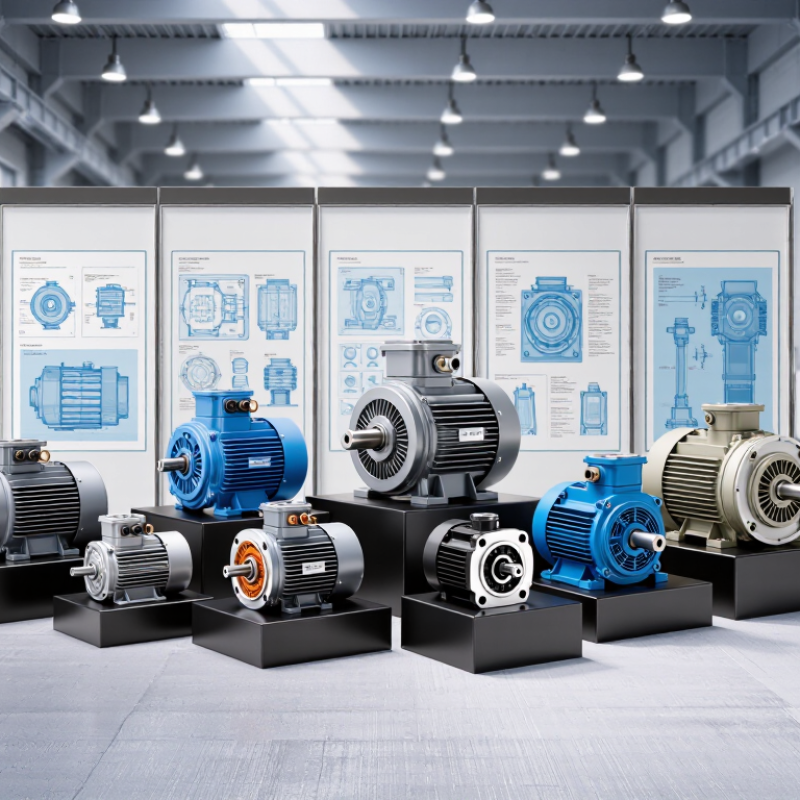
Top 10 Three Phase Motor Types for Global Buyers

Three-Phase Motor Classification and Global Buying Factors

Three-phase motors fall into several practical classes. Squirrel-cage induction motors suit pumps, fans, compressors, and conveyors. They are simple, rugged, and usually affordable. Wound-rotor motors support high starting torque, but their slip-ring maintenance requires attention. Synchronous motors maintain constant speed under changing loads. Permanent-magnet and reluctance motors can improve efficiency, especially with variable-speed drives. The classification should consider rotor design, speed behavior, starting method, and controller compatibility. No category is perfect.

According to the International Energy Agency’s Energy Efficiency 2023 report, motor-driven systems consume roughly half of global electricity. This makes efficiency a purchasing decision, not a brochure detail. IEC 60034-30-1 classifies motor efficiency from IE1 to IE5. Buyers should verify the tested efficiency at the actual load, not only at rated power. Voltage, frequency, phase balance, duty cycle, ambient temperature, altitude, and enclosure protection also matter. A motor rated for 50 Hz may behave differently on a 60 Hz supply.

Global buyers should request efficiency curves, vibration limits, insulation class, bearing details, and routine test records. IEC and NEMA dimensions may not align, even when power ratings appear similar. A common mistake is selecting by kilowatts alone. That approach can create overheating, poor starting, or unexpected installation costs. Procurement teams should also examine spare-part access and local service skills. The cheapest quotation can become expensive after one year. Real operating data is still better than confident assumptions.

Top 10 Three-Phase Motor Types for Global Buyers

Three-Phase Motor Classification and Global Buying Factors

How to read this chart: The values show representative rated-load efficiency levels commonly associated with each motor architecture. Actual performance depends on power rating, speed, duty cycle, cooling method, inverter operation, and applicable IEC or NEMA requirements.

Global buying factors: Buyers should compare efficiency class, supply voltage and frequency, rated speed, starting torque, variable-frequency-drive compatibility, enclosure and IP rating, insulation system, duty cycle, ambient conditions, certifications, spare-parts availability, and total cost of ownership.

Induction Motor Types: Squirrel-Cage, Wound-Rotor, and Double-Cage

Induction motors remain a practical choice for many global industrial buyers. Squirrel-cage motors are simple, rugged, and usually cost-effective. Their rotor has no brushes or slip rings. This reduces maintenance in dusty factories and busy production lines. They suit pumps, fans, compressors, and conveyors with stable starting loads. However, direct starting can create high current and mechanical stress.

Wound-rotor motors use slip rings and external resistance during startup. They provide strong starting torque for cranes, mills, crushers, and heavily loaded conveyors. Maintenance is higher, especially around brushes and slip-ring surfaces. Double-cage motors combine two rotor cage designs. The outer cage supports high starting torque, while the inner cage improves running efficiency. In practical installations, this design can handle demanding starts without the maintenance burden of a wound rotor. Selection is not always obvious. A rough rule can fail when load inertia, voltage quality, or operating cycles change.

Tips: Check voltage, frequency, enclosure rating, duty cycle, and ambient temperature before ordering. Ask for starting-current and torque data, not only rated power. Confirm shaft dimensions and mounting details with the equipment drawing. Engineers sometimes overlook ventilation in hot rooms. That mistake can shorten insulation life. A simple site survey can prevent an expensive mismatch.

Synchronous Motor Types: Wound-Field, Permanent-Magnet, and Reluctance

For global buyers, synchronous motors deserve close attention in three-phase equipment. Their speed follows supply frequency and pole count, making them suitable for compressors, pumps, conveyors, and large process lines. A 400-volt motor may still require different protection in another market. Confirm frequency, voltage, insulation class, and local installation rules before ordering.

Wound-field synchronous motors use rotor windings supplied with direct current. Operators can adjust excitation and improve power factor under changing loads. This design suits large machines that run continuously, such as mills or high-capacity pumps. However, excitation systems add maintenance points. Slip rings, brushes, or brushless components need careful inspection in dusty rooms. Field experience shows that neglected cooling often causes more trouble than the rotor itself.

Permanent-magnet motors use embedded or surface magnets. They offer high efficiency, compact dimensions, and strong performance at variable speeds. Yet high temperatures can weaken magnets, while material availability may affect long-term purchasing plans. Reluctance motors avoid rotor magnets and rotor windings. Their simple rotor can handle harsh service, but they usually need an intelligent drive for accurate control. Torque ripple and acoustic noise may also require testing. The choice is rarely perfect. A quiet laboratory result may not match a hot factory floor, so buyers should request load data, efficiency curves, bearing details, and a realistic commissioning plan.

Specialized Motor Types: Servo, Switched-Reluctance, and Axial-Flux

Servo, switched-reluctance, and axial-flux motors deserve careful attention in any global three-phase motor shortlist. The International Energy Agency reported that electric motor systems consume more than 40% of worldwide electricity, with industry representing the largest share. Small efficiency gains therefore matter. Servo motors deliver precise torque, speed, and position control for robotics, packaging, machine tools, and conveyors. Their encoder feedback supports accurate motion. However, installation requires tuning, compatible drives, and trained technicians.

Switched-reluctance motors use a simple rotor without permanent magnets or rotor windings. This design can tolerate high temperatures and harsh operating conditions. The U.S. Department of Energy’s 2021 Motor Systems Market Assessment identified motor-driven systems as roughly 69% of U.S. industrial electricity use. That figure makes rugged, efficient alternatives commercially relevant. Switched-reluctance systems may reduce material concerns, but torque ripple and acoustic noise remain practical weaknesses. The comparison is not clean.

Axial-flux motors place magnetic flux along the shaft’s direction, creating a compact, disc-shaped package. Their short magnetic path can support high torque density, especially where space and weight are restricted. Recent technical reviews in IEEE publications describe strong potential for electric mobility, automation, and aerospace equipment. Yet production methods, cooling design, and supply-chain capacity are still developing. A laboratory advantage can disappear in a dusty factory. Buyers should request measured efficiency maps, thermal limits, service records, and drive compatibility data. Claims need testing.

Comparing Efficiency, Controls, Standards, Maintenance, and Cost

Top 10 Three Phase Motor Types for Global Buyers

Global buyers commonly compare squirrel-cage induction, wound-rotor, synchronous, permanent-magnet synchronous, synchronous-reluctance, switched-reluctance, servo, axial-flux, two-speed, and slip-ring motors. Efficiency depends on the load, not only the nameplate. The International Energy Agency reports that electric motor systems consume roughly 43–46% of global electricity. Small efficiency gains can therefore reduce substantial operating costs. A high-efficiency induction motor suits pumps and fans, while permanent-magnet and synchronous-reluctance designs can perform better under variable loads. They usually require more complex controls.

Controls change the buying decision. Variable-frequency drives improve speed control and can reduce throttling losses, but harmonics, cooling, and commissioning require attention. Servo motors offer precise positioning, whereas wound-rotor motors support demanding starting conditions. Standards also matter. IEC 60034-30-1 defines international motor efficiency classes, while regional rules may require different testing, labeling, or minimum efficiency levels. Check voltage, frequency, enclosure rating, insulation class, and certification before ordering. A familiar motor may still fail at altitude, humidity, or unstable power conditions.

Maintenance costs are often underestimated. Bearings, alignment, lubrication, encoder feedback, and drive filters need planned inspection. The U.S. Department of Energy’s Motor System Market Assessment identifies motor systems as a major share of industrial electricity use, strengthening the case for lifecycle analysis. Initial price is only one line. Energy, spare parts, downtime, and technician access matter more over years. Axial-flux and switched-reluctance motors may offer useful performance, but supply-chain familiarity is uneven. That is uncomfortable, yet important. A spreadsheet cannot fully predict field behavior.

Top 10 Three Phase Motor Types for Global Buyers - Comparing Efficiency, Controls, Standards, Maintenance, and Cost

Motor Type Typical Full-Load Efficiency Control and Starting Applicable Standards and Practices Maintenance Profile Relative Initial Cost Typical Global Applications
Three-Phase Squirrel-Cage Induction Motor Approximately 85%–97%, depending on rating, speed, and efficiency class Direct-on-line, star-delta, soft starter, or variable-frequency drive; robust across a wide speed range IEC 60034 series, IEC 60034-30-1 efficiency classes, or NEMA MG 1; enclosure and installation practices vary by region Low to moderate; inspect bearings, cooling passages, insulation, alignment, and vibration Low Pumps, fans, compressors, conveyors, machine tools, HVAC equipment, and general industrial machinery
Three-Phase Wound-Rotor Induction Motor Approximately 88%–95% at rated load; external rotor resistance can increase operating losses Slip rings and external resistors provide high starting torque and controlled acceleration; liquid or electronic starting systems may also be used IEC 60034 series or NEMA MG 1; selection must address slip-ring insulation, rotor circuit protection, and enclosure requirements Moderate to high; brushes, slip rings, bearings, and rotor-resistance equipment require periodic inspection Medium to high Cranes, hoists, mills, crushers, conveyors, elevators, and high-inertia loads requiring controlled starting
Synchronous Reluctance Motor Approximately 90%–97% in well-designed variable-speed systems Normally operated with a dedicated inverter using rotor-position estimation or feedback; not generally suited to direct line starting IEC 60034 performance and testing practices; drive requirements generally follow the IEC 61800 series Low to moderate; no rotor magnets or brushes, but inverter, bearings, insulation, and cooling require attention Medium High-efficiency pumps, fans, compressors, conveyors, and industrial drives with frequent speed variation
Permanent-Magnet Synchronous Motor Approximately 92%–98% across suitable operating ranges; efficiency varies with speed, load, and magnet design Requires an inverter, usually with encoder, resolver, Hall sensors, or sensorless position estimation; excellent speed and torque control IEC 60034 series, IEC 60034-2-1 or applicable test methods, IEC 60034-30-2 for variable-speed motor efficiency evaluation, and IEC 61800 for drives Low mechanical maintenance; assess bearings, feedback devices, insulation, cooling, and possible magnet demagnetization from overheating Medium to high Servo systems, robotics, compressors, electric mobility, precision machinery, pumps, and energy-efficient production equipment
Line-Start Permanent-Magnet Synchronous Motor Approximately 90%–97% at rated operating conditions Can start directly from a three-phase supply using an embedded cage, then synchronize; variable-frequency starting may improve performance IEC 60034 series or NEMA MG 1 where applicable; starting current, synchronization, thermal limits, and power quality must be verified Low to moderate; no brushes, but starting cage stresses, bearings, thermal protection, and magnets require monitoring Medium to high Constant-speed pumps, fans, compressors, and industrial equipment where high efficiency is needed without a full-time inverter
Three-Phase Wound-Field Synchronous Motor Approximately 90%–98% at rated load, depending on excitation and machine size Requires rotor excitation through slip rings and brushes or a brushless exciter; may use automatic synchronizing and power-factor control IEC 60034 series or NEMA MG 1; excitation, synchronizing, protection, and power-factor correction requirements must be coordinated Moderate to high; inspect excitation equipment, brushes or exciter components, bearings, insulation, and cooling systems High Large compressors, pumps, fans, rolling equipment, mills, and installations requiring adjustable power factor or high operating efficiency
Three-Phase Switched-Reluctance Motor Approximately 80%–95%, depending strongly on speed, torque ripple, and converter design Requires a dedicated power converter and rotor-position feedback or estimation; offers wide speed range and high fault tolerance IEC 60034 motor testing practices and IEC 61800 drive safety and performance practices are commonly relevant Low mechanical maintenance; pay close attention to converter reliability, acoustic noise, vibration, bearings, and thermal cycling Medium to high High-speed drives, pumps, fans, appliances, traction-related equipment, and applications needing robust rotor construction
Three-Phase Brushless DC Motor Approximately 85%–95%; performance depends on commutation, speed, load, and controller settings Electronic six-step or trapezoidal commutation using Hall sensors, encoders, or sensorless control; regenerative operation depends on the drive IEC 60034 practices for motor testing, IEC 61800 practices for drive systems, and applicable machinery EMC and electrical safety requirements Low mechanical maintenance; inspect bearings, sensors, connectors, insulation, cooling, and controller components Medium Fans, pumps, compressors, automation equipment, medical devices, material handling, and compact motion systems
Axial-Flux Permanent-Magnet Synchronous Motor Approximately 90%–97% in optimized applications; thermal management is critical at high continuous load Inverter-driven with position feedback or sensorless control; compact axial geometry can provide high torque density IEC 60034 testing, insulation, temperature-rise, enclosure, and rotating-machine safety principles; the axial geometry requires application-specific validation Low mechanical maintenance but higher sensitivity to thermal design, rotor balance, air-gap uniformity, bearings, and assembly accuracy High Compact traction systems, robotics, direct-drive equipment, high-torque-density machinery, and space-constrained installations
Three-Phase Hybrid Stepper Motor Approximately 50%–80% under typical operating conditions; efficiency decreases when holding current remains high at low speed Open-loop pulse control or closed-loop feedback; provides high holding torque and precise incremental positioning but may resonate at certain speeds IEC 60034 principles may apply to the motor; the complete motion system also requires applicable drive, EMC, machinery, and electrical safety compliance Low mechanical maintenance; inspect bearings, couplings, wiring, driver cooling, and position accuracy where feedback is used Low to medium Indexing equipment, packaging machinery, laboratory automation, light CNC systems, and low-to-medium speed positioning applications
Data note: Efficiency figures are indicative engineering ranges for properly selected motors operating near rated conditions. Actual results depend on rated power, speed, duty cycle, voltage, load profile, cooling, inverter losses, installation conditions, and the applicable test method. Standards listed are commonly relevant references and do not by themselves confirm product certification.

FAQS

What are the main types of three-phase motors?

Common types include induction, wound-rotor, synchronous, permanent-magnet, reluctance, servo, axial-flux, and two-speed motors. Each design has trade-offs. No category is perfect.

Which motor suits pumps, fans, compressors, and conveyors?

A squirrel-cage induction motor often suits these applications. It is rugged, simple, and usually affordable. Check the actual load before choosing.

When is a synchronous motor a better choice?

Synchronous motors maintain steady speed as loads change. They suit continuous-duty compressors, pumps, mills, and large process lines. Their controls and excitation systems may require more maintenance.

What should buyers check besides motor power?

Confirm voltage, frequency, phase balance, duty cycle, temperature, altitude, and enclosure protection. A 50-hertz motor may behave differently on a 60-hertz supply. Kilowatts alone are not enough.

How important is motor efficiency?

Very important. Motor-driven systems use a large share of global electricity. Compare tested efficiency at the real operating load. Rated-power figures can mislead.

Are permanent-magnet motors always the most efficient option?

No. They can provide high efficiency, compact size, and strong variable-speed performance. High temperatures may weaken their magnets. Material availability can also affect future purchasing.

What problems can variable-frequency drives create?

They improve speed control and may reduce throttling losses. However, harmonics, cooling, insulation stress, and commissioning need attention. Control compatibility matters.

How can buyers estimate long-term motor cost?

Include energy use, spare parts, downtime, bearings, lubrication, alignment, and technician access. The cheapest quotation may become expensive after one year. That assumption fails.

What documents should global buyers request?

Request efficiency curves, vibration limits, insulation class, bearing details, and routine test records. Also confirm dimensions, certifications, protection ratings, and service support. Check the curves.

Why should buyers plan commissioning carefully?

Factory conditions may differ from laboratory results. Heat, dust, humidity, altitude, and unstable power can change performance. Real operating data remains better than confident assumptions.

Conclusion

Choosing the right Three Phase Motor requires more than comparing power ratings. Global buyers should first understand the main classifications: induction motors, synchronous motors, and specialized designs. Squirrel-cage motors offer simple construction and dependable operation, while wound-rotor and double-cage motors provide improved starting performance for demanding loads. Synchronous options, including wound-field, permanent-magnet, and reluctance motors, can deliver precise speed control and high efficiency in suitable applications.

Specialized types such as servo, switched-reluctance, and axial-flux motors address needs involving rapid response, compact design, or advanced energy performance. Buyers should compare efficiency, control compatibility, maintenance requirements, operating conditions, safety standards, voltage systems, and total cost of ownership. Certification, service availability, replacement parts, and installation support are also important for international projects. A careful evaluation of load behavior, duty cycle, environmental conditions, and long-term operating expenses helps ensure the selected motor provides reliable performance and practical value across different markets.

Ethan

Ethan

Ethan is a seasoned marketing professional with a deep expertise in our company's innovative product line. With a passion for sharing knowledge and insights, he takes the lead in regularly updating our corporate blog, where he explores industry trends, product features, and effective marketing......